The Supreme Court of India has upheld hanging as a constitutionally permissible method of executing the death penalty. The Court rejected the challenge seeking the adoption of an alternative method of execution in place of hanging. The decision is significant in the context of capital punishment, human dignity and Article 21 of the Constitution.
Death Penalty and Hanging
¨ The death penalty is the most severe form of criminal punishment in India. Under the existing statutory framework, hanging is the prescribed method for carrying out a death sentence.
¨ In the Indian judicial system, the death penalty is intended to be imposed only in the “rarest of rare” cases. This ensures that such an extreme punishment is used only under exceptional circumstances.
Key Highlights of the Judgment
¨ The Supreme Court upheld the constitutional validity of hanging and dismissed the PIL challenging it. It declined to revisit the position established in Deena v. Union of India (1983).
¨ The Court found that the scientific material placed before it did not establish that an alternative method was demonstrably more humane than hanging.
¨ The Court did not treat the issue as permanently closed. Future scientific, medical or empirical evidence that fundamentally alters the assumptions underlying the Deena case could provide grounds for reconsideration.
¨ The Union Government remains free to examine alternative methods of execution, preserving scope for future policy or legislative consideration.
Why Was Hanging Challenged?
¨ Article 21 and dignity: The petitioners argued that the constitutional protection of life and dignity extends to the manner in which a death sentence is executed, and that hanging may involve cruel or excessive suffering.
¨ Scientific uncertainty: They questioned whether the long-drop method reliably produces immediate unconsciousness through cervical fracture. A too-short drop could cause strangulation, while an excessive drop could cause decapitation.
¨ Empirical evidence: The petitioners relied on a 1992 study of the skeletal remains of 34 people hanged in England between 1882 and 1945. A “hangman’s fracture” occurred in only three cases, while six deaths were attributed to asphyxiation.
¨ Alternative methods: They argued that methods such as lethal injection could provide a more humane alternative to hanging.
Why Did the Court Uphold Hanging?
¨ Established precedent: The Court found no reason to depart from Deena v. Union of India, which had upheld hanging as a constitutionally permissible method.
¨ Inconclusive evidence: The petitioners’ scientific material did not sufficiently undermine the reasoning underlying Deena.
¨ Union’s argument: The Union noted that India had recorded only eight executions since 2003, with no recorded botched execution, while lethal injection has faced documented failures in the US.
¨ No proven superior alternative: The Court found that lethal injection, electrocution, lethal gas and shooting had not been shown to offer an advantage over hanging.
Legal Position and Alternatives to Hanging
¨ Judicial Position: Bachan Singh v. State of Punjab (1980) upheld capital punishment subject to the “rarest of rare” doctrine, while Deena v. Union of India (1983) upheld hanging as a valid mode of execution.
¨ Statutory Provision: Section 393(5) of the BNSS prescribes hanging by the neck till death for a death sentence. The provision traces its legislative lineage to the 1861 CrPC.
¨ Law Commission: The 187th Report (2003) recommended lethal injection as an alternative mode of execution and also examined shooting under military laws. Parliament subsequently retained hanging in the BNSS.
¨ Global practices: Retentionist countries use varied methods, including hanging, lethal injection, shooting, beheading and nitrogen hypoxia. However, more than two-thirds of countries have abolished the death penalty in law or practice.
¨ Shooting is used in China, North Korea, Somalia and parts of West Asia. Saudi Arabia uses Beheading by sword. Nitrogen hypoxia, a relatively recent method, used in the United States.
Significance of the Verdict
¨ Legal clarity: The judgment confirms that hanging remains constitutionally permissible under India’s existing framework.
¨ Evidence-based review: It establishes that replacing the existing method would require strong scientific, medical or empirical evidence.
¨ Scope for future change: The Court has left the issue open to reconsideration if new evidence fundamentally changes the existing scientific understanding.
¨ Policy space: The Union Government remains free to explore alternative methods, keeping the question open for future legislative or policy consideration.
Supreme Court Upholds Hanging as a Constitutionally Permissible Method of Executing the Death Penalty
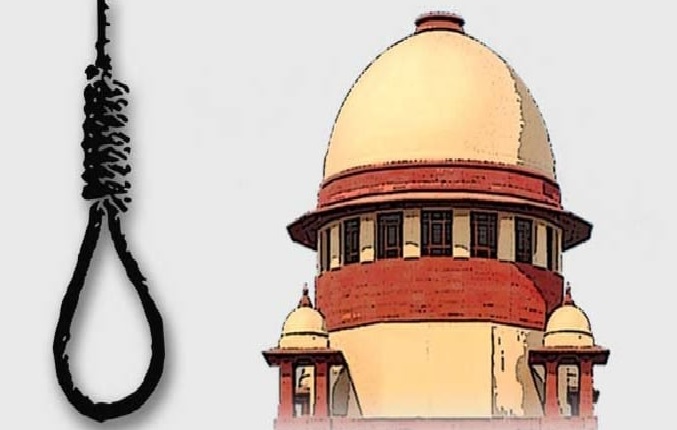
Supreme
Court Upholds Hanging as a Constitutionally Permissible Method of Executing the
Death Penalty