ISRO Conducts First Successful Ground Test
of SOLVE Solid Motor for Gaganyaan Mission
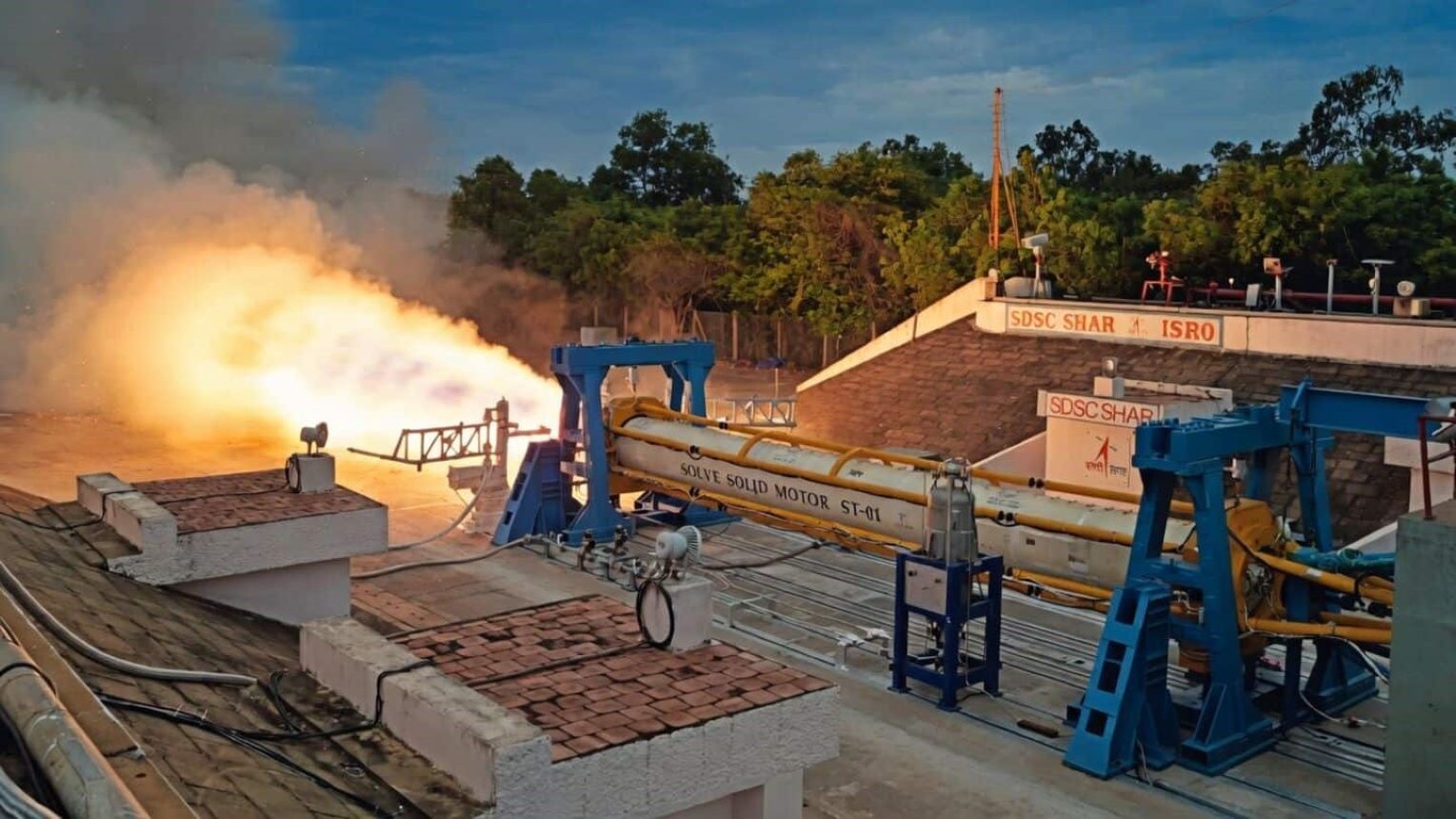
ISRO successfully conducted the first ground test of
the SOLVE (Sub-Orbital Launch Vehicle for Experiments) solid motor recently,
marking an important milestone in the Gaganyaan Human Spaceflight Programme.The
test was conducted at the Static Test Facility of Satish Dhawan Space Centre
(SDSC-SHAR), Sriharikota, and all motor performance parameters met the expected
objectives.SOLVE is being developed primarily for conducting Integrated
Parachute Tests (IPTs) to validate the Crew Module’s deceleration and recovery
systems under realistic mission conditions.Future SOLVE missions will carry a
Gaganyaan Crew Module to an altitude of 10–17 km, enabling end-to-end
validation of the parachute recovery sequence before splashdown in the sea.ISRO
highlighted that the development of SOLVE will provide greater flexibility in
conducting Gaganyaan test missions by simulating different conditions that may
arise during an actual human spaceflight mission.
About SOLVE
¨
SOLVE (Sub-Orbital Launch
Vehicle for Experiments) is a solid motor-based sub-orbital test vehicle being
developed by ISRO to support technology validation for the Gaganyaan programme.
¨
The vehicle is powered by
a solid motor derived from the PSOM-XL strap-on motor used in PSLV missions,
adapted for sub-orbital experimental testing.
¨
It has been conceived
primarily for Integrated Parachute Tests, which are critical for validating the
Crew Module’s deceleration and recovery systems before crewed missions.
¨
During test flights, the
Crew Module will be released at a designated altitude and recovered through a
carefully sequenced parachute deployment system, closely replicating actual
recovery conditions.
¨
SOLVE provides a
dedicated and flexible experimental platform for repeated validation of
critical recovery technologies without requiring a full-scale orbital mission.
Significance for Gaganyaan
¨
Safe descent and
splashdown constitute one of the most critical phases of a human spaceflight
mission; SOLVE will help validate the systems responsible for the safe return
of astronauts.
¨
By enabling repeated
tests under varied mission scenarios, SOLVE will reduce mission risks and
enhance the reliability of future crewed Gaganyaan missions.
Gaganyaan Mission
¨
Gaganyaan is India’s
first human spaceflight programme aimed at demonstrating the capability to send
a crew of three astronauts to a Low Earth Orbit (LEO) of about 400 km for a
mission of three days and bring them back safely through splashdown in Indian
waters.
¨
The programme involves a
series of uncrewed qualification missions, abort tests and technology
demonstrations before the eventual crewed mission.
Its major components include:
¨
Human-Rated LVM3 (HLVM3)
launch vehicle;
¨
Crew Module (CM) for
astronaut habitation;
¨
Service Module (SM) for
propulsion and mission support;
¨
Crew Escape System (CES)
for emergency crew evacuation.
Successful completion of Gaganyaan will make India the
fourth country, after the United States, Russia and China, to independently
demonstrate human spaceflight capability.The programme is also expected to
provide the technological foundation for future initiatives such as the
Bharatiya Antariksh Station and long-duration human spaceflight missions.



 scheme will continue until September 30, 2026.jpg)