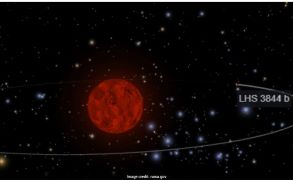
James Webb Space Telescope conducted a
direct study of the rocky exoplanet LHS 3844 b
¨ James Webb Space
Telescope conducted a direct study of the rocky exoplanet LHS 3844 b on 4 May
2026.
¨
LHS 3844 b is classified
as a super-Earth exoplanet.
¨
It is located around 49
to 50 light-years away from Earth.
¨
The planet is about 30
percent larger than Earth.
¨ James Webb Space
Telescope was developed by NASA, European Space Agency, and Canadian Space Agency.
¨
The telescope operates in
the infrared spectrum and carries instruments such as the Mid-Infrared
Instrument (MIRI).
¨
MIRI is used to study
heat signatures and molecular signals from distant celestial objects.
¨
LHS 3844 b is a tidally
locked exoplanet.
¨
One side of the planet
permanently faces its host star.
¨ The star-facing side
reaches temperatures of nearly 1,340 degrees Fahrenheit or around 725 degrees
Celsius.
¨
Observations made by MIRI
during 2023 and 2024 showed that the planet is dark, extremely hot, barren, and
lacks an atmosphere.
¨
Scientists studied the
planet’s geology by analysing heat emitted from its surface.
¨ The surface appears to
consist of basaltic or igneous mantle rock similar to Mercury or the Moon.
¨ No evidence of Earth-like silica-rich or granite-rich crust was detected.
¨ The study relates to the field of exoplanet geology, which examines the physical and geological properties of planets beyond the Solar System.