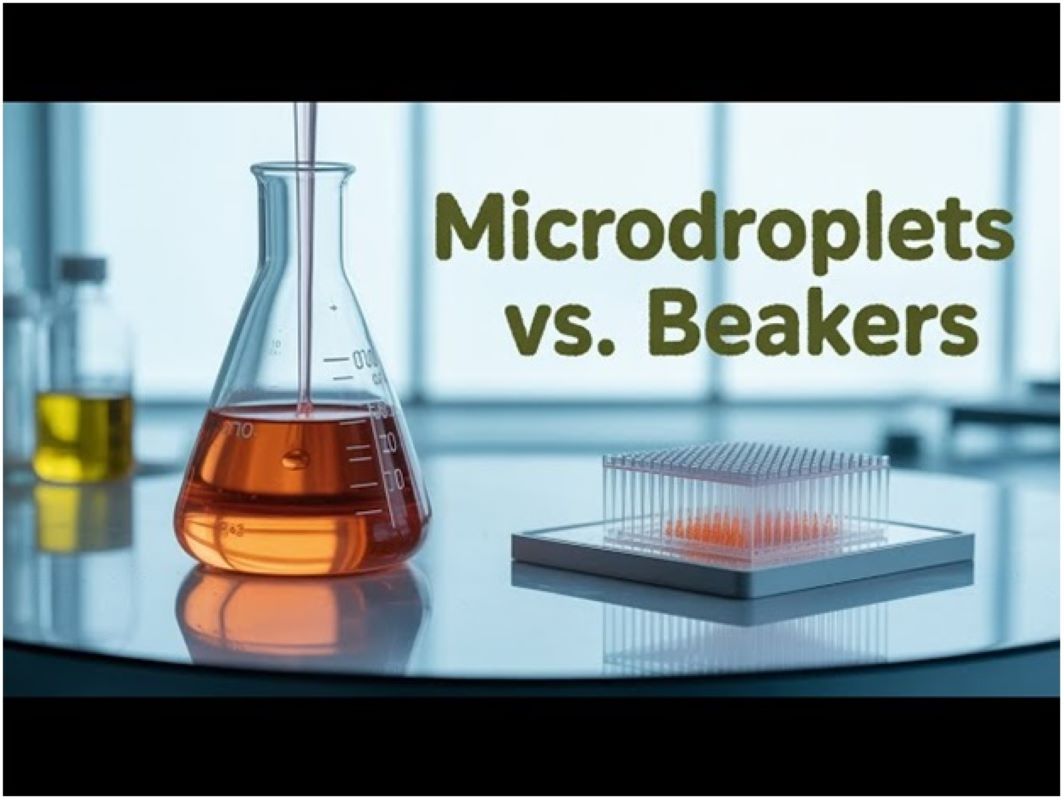
Microdroplet Chemistry: A Revolutionary Step Towards Faster and Greener Chemical Reactions
Science is constantly discovering innovative ways to make chemical reactions faster, cleaner, and more sustainable. One of the latest breakthroughs in modern chemistry is Microdroplet Chemistry, a technique that dramatically speeds up chemical reactions using microscopic droplets of water. In June 2026, scientists achieved a major milestone by successfully performing catalyst-free skeletal editing using water microdroplets, opening exciting possibilities for pharmaceutical research and green chemistry.
For competitive exam aspirants, this development is important because it combines concepts from chemistry, scientific innovation, pharmaceuticals, and environmental sustainability.
What is Microdroplet Chemistry?
Microdroplet Chemistry is an advanced chemical technique in which reactions take place inside extremely tiny liquid droplets, usually water droplets ranging from micrometers (µm) to nanometers (nm) in size. Unlike conventional laboratory reactions that occur in bulk liquid, reactions inside these miniature droplets happen significantly faster because of their unique physical and chemical environment. This technology enables scientists to perform complex chemical transformations rapidly while reducing energy consumption and minimizing the need for chemical additives.
How Does Microdroplet Chemistry Work?
In traditional chemistry laboratories, reactions often require:
- High temperatures
- High pressure
- Chemical catalysts
- Long reaction times
However, in microdroplet chemistry:
- Reactions occur within microscopic water droplets.
- The enormous surface-area-to-volume ratio accelerates molecular interactions.
- Many reactions proceed naturally without external catalysts.
- Energy consumption is significantly reduced.
As a result, chemical synthesis becomes faster, safer, and environmentally friendly.
What is Skeletal Editing?
Skeletal editing is one of the most advanced techniques in organic chemistry, where scientists modify the core framework (molecular scaffold) of a molecule instead of simply changing its side groups. This allows researchers to convert one useful molecule into another with greater efficiency.
Skeletal editing involves:
- Atom insertion
- Atom deletion
- Atom replacement
- Ring expansion
- Ring contraction
- Heteroatom substitution
These structural modifications help create new molecules with improved pharmaceutical and industrial properties.
Major Scientific Breakthrough in June 2026
In June 2026, a research team led by Shibdas Banerjee at the Indian Institute of Science Education and Research (IISER), Tirupati successfully demonstrated catalyst-free skeletal editing using only water microdroplets. The researchers converted aniline into pyridine without using any external catalyst, proving that water microdroplets alone can facilitate complex molecular transformations. This achievement represents an important advancement in sustainable chemical synthesis.
Another Global Achievement in Microdroplet Chemistry
Around the same time, scientists led by Graham Cooks from Purdue University, along with researchers at Aston Labs, developed another microdroplet-based technique capable of accelerating chemical reactions without:
- High temperatures
- Expensive catalysts
- Additional chemical reagents
Their work further confirmed the enormous potential of microdroplet chemistry for future industrial and pharmaceutical applications.
Why is Microdroplet Chemistry Important?
Microdroplet chemistry offers several advantages over traditional chemical processes.
Key Benefits:
Faster Chemical Reactions
Chemical reactions occur much more rapidly inside microscopic droplets than in conventional bulk solutions.
Catalyst-Free Reactions
Many reactions no longer require expensive or hazardous catalysts.
Green Chemistry
The process reduces:
- Chemical waste
- Energy consumption
- Harmful by-products making it an excellent example of green synthesis.
Cost-Effective Production
Industries can reduce manufacturing costs by lowering energy requirements and minimizing reagent usage.
Environment-Friendly Technology
The technique supports sustainable industrial practices while reducing pollution.
Importance in Drug Discovery
One of the biggest applications of skeletal editing lies in pharmaceutical chemistry. Many life-saving medicines contain nitrogen-containing heterocyclic compounds, which form the backbone of numerous drugs.
According to scientific studies, more than 80% of small-molecule drugs approved by the US Food and Drug Administration (US FDA) between 2013 and 2023 contain nitrogen-based heterocyclic structures. Microdroplet chemistry makes the synthesis and modification of these compounds faster and more efficient.
Applications of Skeletal Editing Scientists use skeletal editing for:
- Drug discovery
- Pharmaceutical research
- Late-stage functionalization
- Molecular diversification
- Organic synthesis
- Medicinal chemistry
- Advanced material science
The technique is particularly valuable in synthesizing important heterocyclic compounds such as:
- Pyridines
- Quinolines
- Other nitrogen-containing ring systems
Why is it Called Green Synthesis?
Green synthesis aims to manufacture chemicals while minimizing environmental impact. Microdroplet chemistry supports this objective by:
- Eliminating unnecessary catalysts
- Lowering energy consumption
- Producing fewer harmful chemicals
- Reducing industrial waste
- Improving overall reaction efficiency
These characteristics make it one of the most promising approaches for sustainable chemical manufacturing.
Key Highlights at a Glance
|
Topic |
Details |
|
Discovery |
Catalyst-free skeletal
editing using water microdroplets |
|
Lead Indian
Scientist |
Shibdas Banerjee |
|
Institution |
IISER Tirupati |
|
International
Researcher |
Graham Cooks |
|
Technology |
Microdroplet Chemistry |
|
Major Achievement |
Conversion of aniline into
pyridine without catalyst |
|
Main Advantage |
Faster chemical
reactions with lower energy consumption |
|
Importance |
Green chemistry and sustainable
chemical synthesis |
|
Pharmaceutical
Relevance |
Synthesis of
nitrogen-containing heterocyclic drugs |
Conclusion
Microdroplet Chemistry represents a major leap forward in modern chemical science by enabling faster, cleaner, and more sustainable reactions. The successful demonstration of catalyst-free skeletal editing using water microdroplets highlights the immense potential of this technology in pharmaceutical development, organic synthesis, and green chemistry. As the demand for environmentally friendly manufacturing processes continues to grow, microdroplet chemistry is expected to play a transformative role in the future of scientific research and industrial applications.


, Jaipur, developed a low-cost sensor to detect minute amounts of toxic lead (Pb²⁺) ions in drinking water.jpg)
, Chennai demonstrated Blue Swimmer Crab farming technology for the first time in India.jpg)