India-US space cooperation is set to receive a further boost. During the 9th meeting of the India-US Civil Space Joint Working Group, held in Bengaluru, the National Aeronautics and Space Administration (NASA) invited the Indian Space Research Organisation (ISRO) to participate in its Moon Base Programme.
The invitation highlights the growing partnership between India and the United States in lunar exploration and human spaceflight. Both countries have already been expanding cooperation in several areas of space science and technology, and participation in the Moon Base Programme could take this partnership to a new level.
Moon Base Program
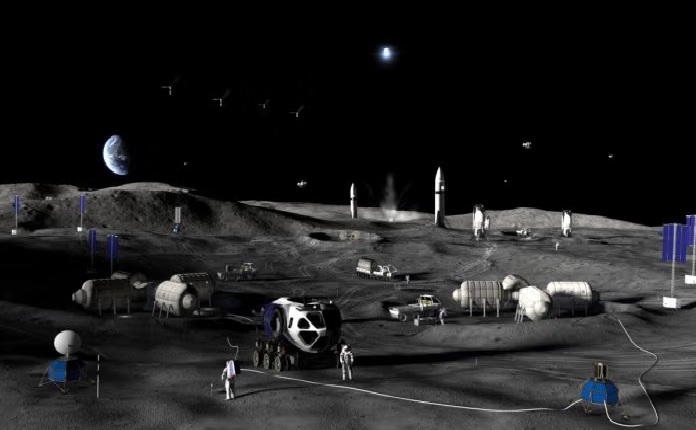
¨ The objective of NASA's Moon Base Program is to establish a sustained human presence near the Moon's South Pole, where astronauts will live, work, and conduct scientific activities for extended periods.
¨ his program was announced as part of initiatives to advance American leadership in the space sector during NASA’s ‘Ignition’ event held on March 24, 2026.
It is being developed in three phases
1. Phase 1 (Current–2029): Experimentation and Learning — Robotic missions, technology demonstrations, and exploration activities will be conducted to understand the lunar South Pole environment and establish reliable access to the lunar surface.
2. Phase 2 (2029–2032): Initial Habitation — Infrastructure for energy, communications, mobility, and habitation will be established, and initial operations on the lunar surface will commence.
3. Phase 3 (2032 onwards): Sustained Human Presence — Semi-permanent habitats and advanced energy and logistics systems will be developed, and teams of astronauts will rotate regularly for long-duration human operations on the Moon.
The lunar South Pole is the program's primary focus because water ice is believed to exist in the permanently shadowed regions there. Additionally, this region offers significant opportunities for scientific research and for testing technologies essential for future deep-space missions.NASA aims to develop the infrastructure required for long-term lunar operations by bringing together government capabilities, commercial companies, and international partners.
Why does NASA want to include India in this program?
¨ Collaboration based on the Artemis Accords: India's participation is based on the Artemis Accords, which India signed in 2023 as the 27th signatory nation. These accords establish principles for peaceful, sustainable, and responsible space exploration. Existing India-US Space Cooperation: NASA and ISRO have already established significant collaboration on the NASA-ISRO Synthetic Aperture Radar (NISAR) mission and in the field of human spaceflight. This includes the participation of Indian astronaut Group Captain Shubhanshu Shukla in the Axiom-4 mission to the International Space Station.
¨ During the latest meeting, an agreement was reached to advance discussions on the exchange of open scientific data under the Artemis Accords and to collaborate on future science and human spaceflight technologies.
¨ India's Lunar Capabilities: India has demonstrated significant capabilities in lunar exploration through the Chandrayaan program. Notably, Chandrayaan-3 successfully achieved a soft landing in the lunar south polar region in 2023.
¨ Complementary Space Ambitions: India is itself pursuing an ambitious plan for human spaceflight and lunar exploration, which includes the Gaganyaan mission, the Indian Space Station, and a proposed crewed lunar mission by 2040.
¨ Thus, including India in the program would integrate ISRO’s lunar exploration expertise and technical capabilities with NASA’s comprehensive lunar exploration architecture and international partnership framework.
¨ Significance of the Moon Base Program
¨ Establishing a Sustained Human Presence: The program aims to establish a sustained human presence near the lunar south pole, where astronauts will live, work, and conduct scientific activities for extended periods.
¨ Advancing Lunar Science: A prolonged human presence on the Moon will enable long-term studies of its geological structure, resources, and environment. This will also aid in understanding the early history of the Moon and the solar system.
¨ Utilization of Lunar Resources: Exploring the lunar south pole can facilitate the study and potential utilization of resources—such as water ice found in permanently shadowed regions. Development of space technologies: This program can foster advancements in robotics, autonomous systems, lunar surface mobility, communications, power generation, and habitat systems—all of which are essential for long-duration operations on the Moon.
¨ Preparation for deep space exploration: The technologies developed and the operational experience gained on the Moon can serve as a crucial foundation for future missions to Mars and other deep space exploration endeavors.
NASA Invites ISRO to Join Moon Base Programme
NASA Invites ISRO to Join Moon Base
Programme



 Bill, 2026.jpg)