NITI Aayog
Governing Council Meeting Focuses on Inclusive Human Development for Viksit
Bharat @2047
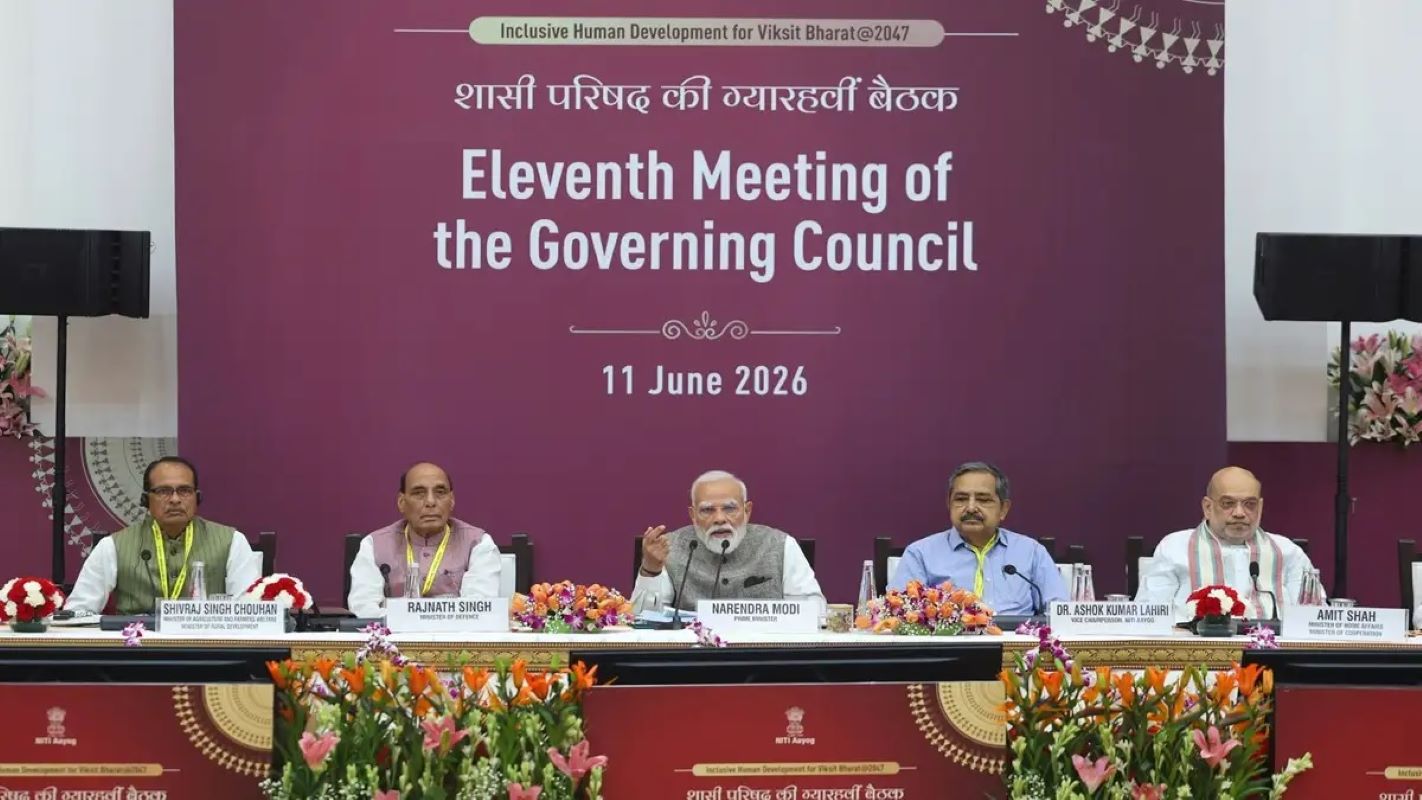
Prime Minister Narendra Modi chaired
the 11th Governing Council Meeting of NITI Aayog at the Rashtrapati Bhavan
Cultural Centre in New Delhi. The theme of the meeting was “Inclusive Human
Development for Viksit Bharat @2047”, reflecting the government's commitment to
building a developed, inclusive, and prosperous India by the centenary year of
Independence.The Governing Council is the highest decision-making body of NITI
Aayog and comprises Chief Ministers of States, Lieutenant Governors of Union
Territories, and senior Union Government officials. The meeting provided a
platform for cooperative federalism and discussions on key developmental
priorities.
More on the News
¨
The
meeting brought together Chief Ministers, Lieutenant Governors, Union
Ministers, and senior officials to deliberate on strategies for achieving
inclusive human development and translating the vision of Viksit Bharat into
measurable outcomes.
¨
Discussions
focused on four pillars of the Inclusive Human Development Framework:
Foundational Human Capital and Future-Ready Skills; Productive Employment,
Entrepreneurship and Decentralised Growth; Health, Nutrition and Well-being;
and Equity and Dignity for All.
¨
The
Governing Council deliberated on measures to promote entrepreneurship,
strengthen skilling initiatives, and create sustainable employment
opportunities across the country.
¨
It
also reviewed recommendations of the 5th National Conference of Chief
Secretaries (December 2025)and discussed an implementation roadmap leveraging
governance reforms, Digital Public Infrastructure (DPI), partnerships,
convergence, and data-driven systems to ensure accountability and measurable
impact.
NITI Aayog
(National Institution for Transforming India)
¨
On
January 1, 2015, NITI Aayog was established as the successor to the Planning
Commission through an executive resolution of the Government of India (Union
Cabinet).
¨
It
is a non-constitutional body (not created by the Constitution) and a
non-statutory body (not created by an Act of Parliament).
¨
NITI
Aayog serves as the premier policy think tank of the Government of India,
providing both directional and policy inputs.
¨
It
is responsible for designing strategic and long-term policies and programmes
for national development.
¨
It
also provides technical advice to both the Centre and States.
¨
The
institution marks a significant shift from the Planning Commission era:
¨
The
one-way flow of policy from Centre to States is replaced by a genuine
partnership between the Centre and States.
¨
It
adopts a collaborative approach instead of the earlier command-and-control
model.
¨
In
line with the spirit of federalism, it follows a bottom-up approach,
incorporating inputs from various stakeholders rather than a top-down model.
Composition of
NITI Aayog:
¨
Chairperson:
Prime Minister of India.
¨
Governing
Council: Comprises Chief Ministers of all States, Chief Ministers of Union
Territories with legislatures, and Lt. Governors of other Union Territories.
¨
Regional
Councils: Formed to address specific issues affecting multiple states or
regions.
Convened by the
Prime Minister
¨
Chaired
by the Chairperson of NITI Aayog or their nominee
¨
Special
Invitees: Experts, specialists, and practitioners nominated by the Prime
Minister.
Full-Time
Organisational Framework
¨
Vice-Chairperson:
Appointed by the Prime Minister, enjoys Cabinet rank.
¨
Full-Time
Members: Hold the rank of Minister of State.
¨
Part-Time
Members: From leading universities and research institutions (on rotation).
¨
Ex-Officio
Members: Up to four Union Ministers nominated by the Prime Minister.
¨
Chief
Executive Officer (CEO): Appointed by the Prime Minister for a fixed tenure.
¨
Secretariat:
Provides administrative and technical support.
Governing Council
of NITI Aayog
¨
The
Governing Council came into effect on 16 February 2015 through a notification
of the Cabinet Secretariat.
¨
It
was reconstituted on 19 February 2021.
¨
It
is the highest decision-making and consultative body of NITI Aayog.
¨ The Council embodies the principle of Cooperative Federalism by providing a platform for the Centre and States to evolve a shared vision of national priorities and development strategies.
¨ It discusses inter-sectoral, inter-departmental, and federal issues to accelerate implementation of the national development agenda.

.jpg)