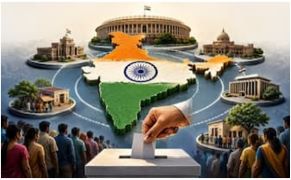
One Nation, One Election’ May Save ₹7 Lakh
Crore and Boost India’s GDP
The Joint Parliamentary Committee (JPC) examining the
proposed framework for ‘One Nation, One Election’ (ONOE) has recently stated
that conducting simultaneous elections in India could save nearly ₹7 lakh crore
over time. The committee also noted that the reform could potentially increase
India’s Gross Domestic Product (GDP) by up to 1.6%. The proposal aims to make
the electoral process more efficient, cost-effective, and administratively
streamlined.
More on the News
¨
The JPC is currently
examining the Constitution (One Hundred and Twenty-Ninth Amendment) Bill, 2024
and the Union Territories Laws (Amendment) Bill, 2024, which seek to
operationalise simultaneous elections in India.
¨
The JPC is headed by P.
P. Chaudhary and has a total of 39 members, including 27 MPs from the Lok Sabha
and 12 from the Rajya Sabha, apart from the Chairperson.
¨
The Constitution (One
Hundred and Twenty-Ninth Amendment) Bill, 2024, primarily seeks to enable
simultaneous elections to the Lok Sabha and State Legislative Assemblies, while
synchronisation of local body elections has been proposed separately as a
subsequent phase requiring additional constitutional amendments and
ratification by at least half of the States.
¨
The idea of ONOE is based
on recommendations of the High-Level Committee chaired by former President Ram
Nath Kovind, whose report was accepted by the Union Cabinet in 2024.
One Nation, One Election (ONOE)
¨
“One Nation, One
Election” refers to the proposal of conducting simultaneous elections to the
Lok Sabha and all State Legislative Assemblies, followed by synchronised local
body elections within a fixed cycle.
¨
At present, elections in
India are conducted separately based on the tenure of individual legislatures,
resulting in frequent election cycles across different states.
¨
India followed
simultaneous elections between 1951–52 and 1967, after which the cycle was
disrupted due to premature dissolution of Assemblies, frequent use of Article
356, and political instability.
Key Challenges in Implementation
¨
Constitutional Amendments:
The recommendations of the Committee require amending several provisions of the
Constitution. It would also require amendments to the Representation of the
People Act (RPA), 1951, which governs the timing of general elections and
elections to state legislative assemblies.
¨
Logistical Requirements:
Implementing simultaneous elections would incur high costs, including the need
for additional EVMs/VVPATs. This expense could run into thousands of crores, as
machines would need replacement every 15 years.
¨ Government Stability: Handling scenarios where governments fall or legislatures dissolve prematurely during their terms poses a democratic challenge. Implementing ONOE may undermine democratic norms and local empowerment efforts.
¨ Impact on Election Spending: ONOE aims to reduce election spending, but it may not effectively tackle the issue of black money in elections.
.jpg)