¨ Prime Minister Narendra Modi introduced the Sapta Dhara framework during his 80th Independence Day address from the Red Fort in New Delhi on 15 August 2026.
¨ Sapta Dhara, also called “Shakti Ki Saptadhara,” aims to achieve the vision of Viksit Bharat by 2047.
The seven pillars of Sapta Dhara are
¨ Manufacturing
¨ Agriculture and food processing
¨ Technology and innovation
¨ Gati Shakti
¨ Self-reliance in defence
¨ Green and blue economy
¨ India’s soft power
Gati Shakti is an integrated infrastructure and logistics planning approach aimed at improving connectivity and coordination among projects.The green economy focuses on low-carbon development and environmentally sustainable activities, while the blue economy focuses on the sustainable use of marine and ocean resources.The manufacturing pillar emphasises cost, quality, and scale, referring to price competitiveness, product standards, and production capacity.Under technology and innovation, the government plans to train 1 crore youth in Artificial Intelligence (AI) over the next year.Artificial Intelligence (AI) is a branch of computer science that enables machines to perform tasks such as learning, pattern recognition, and language processing.The defence pillar focuses on self-reliance in defence, including greater domestic production of military equipment, platforms, and defence systems.India has set a target of achieving 100 GW of nuclear energy capacity by 2047.Nuclear energy is produced through controlled nuclear fission reactions in reactors.India operates Pressurised Heavy Water Reactors (PHWRs) as well as imported Light Water Reactor (LWR) technology.Five new nuclear reactors are planned to become operational over the next 6–7 years.India’s domestic piped natural gas network has expanded from 70 cities to more than 700 cities over the past 12 years.Around 1.75 crore households are connected to the piped natural gas network.
PM Narendra Modi introduced the Sapta Dhara framework during his 80th Independence Day address from the Red Fort in New Delhi on 15 August 2026
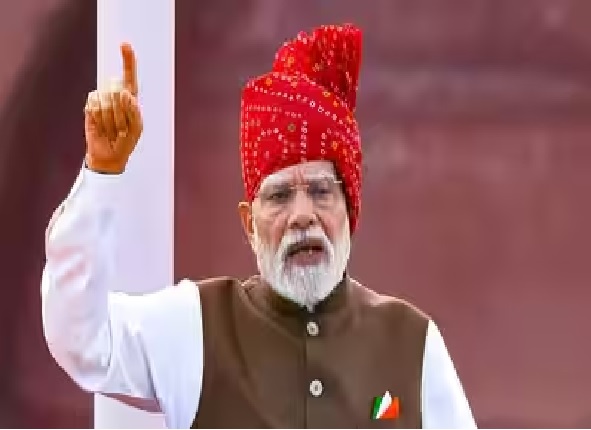
PM Narendra Modi introduced the Sapta Dhara framework during his 80th Independence Day address from the Red Fort in New Delhi on 15 August 2026

 Amendment Bill, 2026.jpg)