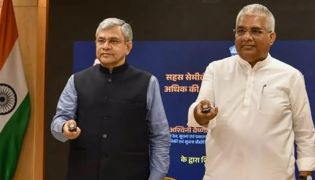
Rajasthan Enters India’s Semiconductor
Ecosystem with Bhiwadi EMC and First SME-Based ATMP/OSAT Facility
Rajasthan has formally entered India’s strategic
semiconductor ecosystem with the launch of a new Electronics Manufacturing
Cluster (EMC) in Bhiwadi, along with the commercial operations of India’s first
SME-based semiconductor Assembly, Testing, Marking, and Packaging (ATMP/OSAT)
facility. This development marks a significant step in strengthening India’s
domestic electronics and semiconductor manufacturing capabilities.
Electronics
Manufacturing Cluster (EMC)
¨
The Electronics
Manufacturing Cluster (EMC) developed by ELCINA at Salarpur, Khushkhera,
Bhiwadi, Rajasthan, has been developed over 50.3 acres with a project cost of
₹46.09 crore.
¨
The Government of India
has provided direct support of ₹20.24 crore under the EMC scheme.
¨
The cluster is equipped
with testing and training centres and a dedicated Skill Development Centre.
¨
The EMC has attracted
planned investments of over ₹1,200 crore by 20 companies.
¨
Eleven companies are
currently operational with cumulative investments of over ₹900 crore and
employment for over 2,700 persons.
Semiconductor ATMP/OSAT Facility
¨
The Semiconductor
ATMP/OSAT facility of Sahasra Semiconductors Pvt. Ltd. is India’s first Small
and Medium Enterprise (SME) to start commercial production of semiconductor
chips.
¨
Developed under MeitY’s
Scheme for Promotion of Manufacturing of Electronic Components and
Semiconductors (SPECS), the facility has been set up with an investment of over
₹150 crore.
¨
The 57,000 sq. ft.
facility is equipped with Class 10K and 100K cleanrooms.
¨
The facility will package
memory chips, LED driver ICs, eSIMs and RFID products.
¨
The unit currently has an
annual packaging capacity of 60 million semiconductor units and plans to scale
up to 400–600 million units annually over the next 2–3 years.
¨
More than 60% of its
production is being exported to markets including the United States, Germany,
France, Eastern Europe, China, and Nepal.
Government Schemes Related to
Semiconductor and Electronics Manufacturing
¨
Scheme for Promotion of
Manufacturing of Electronic Components and Semiconductors (SPECS) was notified
on 1st April 2020 to offset the disability for domestic manufacturing of
electronic components and semiconductors.The scheme provides a financial
incentive of 25% on the capital expenditure for the identified list of
electronic goods that comprises the downstream value chain.Till February 2026,
SPECS has led to a cumulative investment of ₹18,609 crore and employment
generation of 64,443.
¨
Semicon India Programme:
The Government launched the Semicon India Programme in January 2022 to develop
a complete semiconductor ecosystem ranging from design, fabrication, assembly,
testing, packaging and module manufacturing.The Government has approved 10
projects with investment commitments of about ₹1.6 lakh crore, and commercial
production from Micron and Kaynes plants has commenced.Approved companies under
the programme have entered into technology partnerships with global
semiconductor companies from Taiwan, Japan, Korea, US, UK and Malaysia.
¨
Electronics Manufacturing
Clusters (EMC and EMC 2.0) Schemes: The government launched EMC (2012) and EMC
2.0 (2020) schemes to provide world-class infrastructure, logistics, and plug-and-play
facilities for electronics manufacturing.Under these schemes, 30 Greenfield
Electronics Manufacturing Clusters (EMCs) and 5 Common Facility Centres (CFCs)
have been established across 18 States.These clusters have mobilized
investments of more than ₹30,000 crore and generated around 90,000 jobs.
¨
Electronics Components
Manufacturing Scheme (ECMS): The government launched ECMS to deepen the supply
chain ecosystem and develop a robust electronics component ecosystem in the
country.The scheme aims to attract investments in Printed Circuit Boards
(PCBs), passive components, electro-mechanical components, sub-assemblies,
camera modules and optical transceivers.Till date, 75 applications approved
under ECMS are expected to attract investments of ₹61,671 crore and generate
65,040 jobs.
Significance
¨
Rajasthan’s Entry into
Semiconductor Industry: Rajasthan has formally entered India’s semiconductor
ecosystem and the strategically critical semiconductor industry.
¨ Boost to India’s
Electronics and Semiconductor Manufacturing: The event marks a significant
milestone in India’s journey towards becoming a global hub for electronics
manufacturing and semiconductors under Make in India, Digital India and
Atmanirbhar Bharat.
¨ MSME-Led Semiconductor
Manufacturing: India has taken a notable step in its semiconductor ambitions
with the inauguration of its first SME-led chip manufacturing facility.
¨ Export-Oriented Semiconductor Production: More than 60 per cent of the facility’s production is being exported to international markets, highlighting India’s growing integration into the semiconductor supply chain.
¨ Development of Bhiwadi as Manufacturing Hub: Rajasthan Semiconductor Policy 2026 aims to develop the region near Delhi NCR into a manufacturing hub.

.jpg)