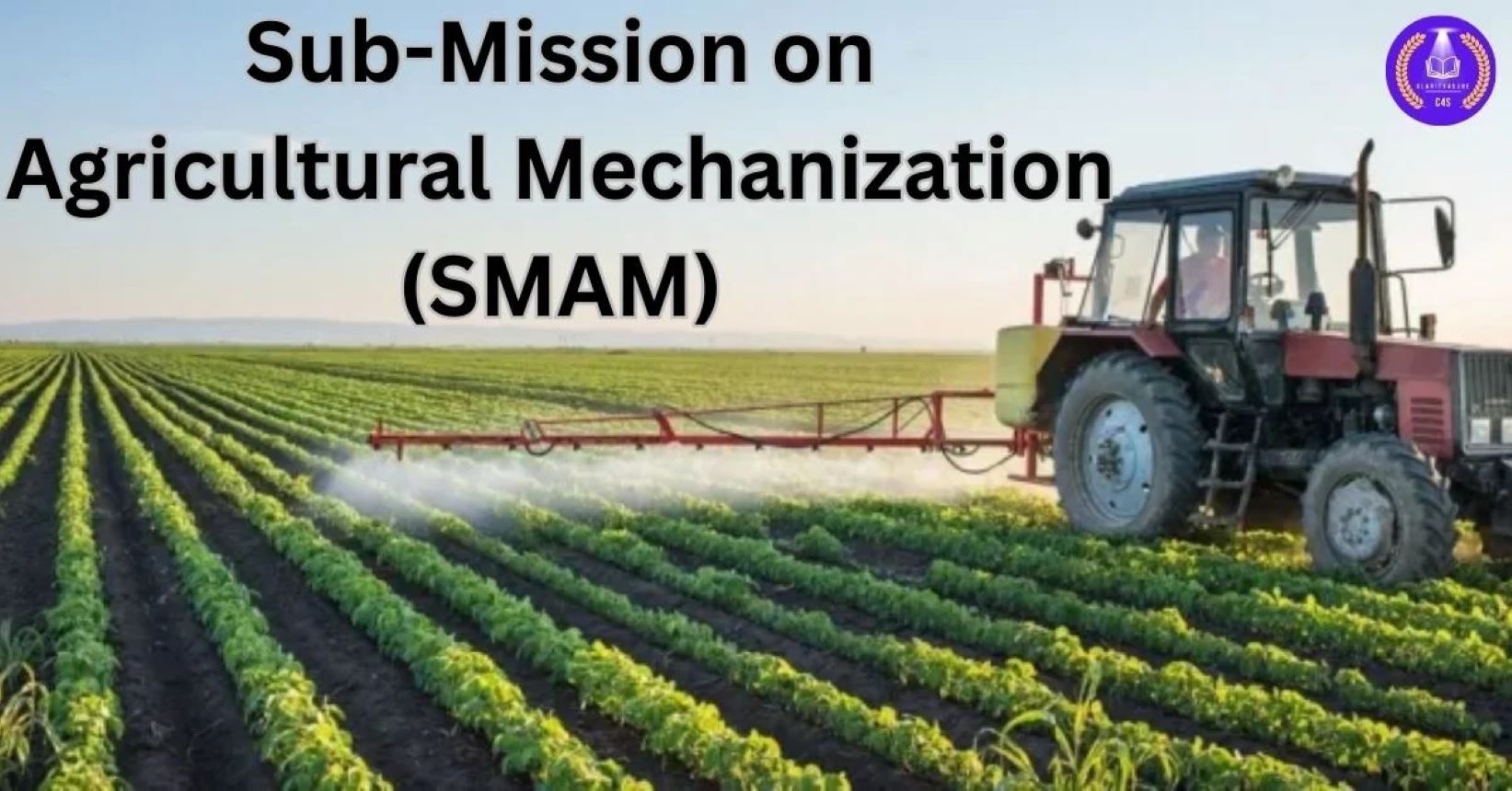
Sub-Mission on Agricultural Mechanization
Sub-Mission on Agricultural Mechanization (SMAM) is
witnessing a rapid expansion across the country, enhancing farmers’ access to
modern agricultural machinery and improving farm productivity and
efficiency.
More on the News
¨
Since its launch, SMAM
has emerged as a key intervention for promoting inclusive farm mechanization,
particularly among small and marginal farmers and other underserved groups.
¨
The scheme has
significantly expanded mechanization infrastructure through Custom Hiring
Centres (CHCs), Farm Machinery Banks (FMBs) and Hi-Tech Hubs, improving access
to farm equipment on a shared basis.
¨
Recent efforts under the
scheme have also focused on promoting drone-based and precision agriculture
technologies to modernize Indian farming.
Sub-Mission on Agricultural Mechanization
(SMAM)
¨
Launched in 2014–15, the
Sub-Mission on Agricultural Mechanization (SMAM) is a Centrally Sponsored
Scheme under the Rashtriya Krishi Vikas Yojana (RKVY).
¨
For most states, the
funding pattern is 60:40, while for North-Eastern and Himalayan states, it is
90:10. UTs get 100% central assistance.
¨
It seeks to promote farm
mechanization across the country, particularly among farmers with limited
access to modern agricultural machinery and equipment.
¨
The scheme follows a
“reach the unreached” approach to make mechanization affordable, accessible and
inclusive.
Objectives:
¨
Increase the reach of
farm mechanization, particularly among small and marginal farmers and in
regions with low farm power availability.
¨
Improve productivity,
operational efficiency and timeliness of farm operations through adoption of
modern machinery.
¨
Reduce labour drudgery
and cultivation costs while promoting post-harvest management and sustainable
agriculture.
Focus Areas
¨
Promotion of Agricultural
Mechanization: Supports training, demonstrations, testing and post-harvest
mechanization to improve adoption of modern farm technologies.
¨
Financial Assistance for
Agricultural Machinery: Provides DBT-based subsidies for machinery purchase,
with higher support for SC/ST farmers, small and marginal farmers and
beneficiaries in the North-East.
¨
Custom Hiring Centres
(CHCs) and Farm Machinery Banks (FMBs): Facilitates shared access to
agricultural equipment through institutional models, making mechanization
affordable for farmers who cannot purchase machinery individually.
¨
Hi-Tech and
High-Productivity Equipment Hubs: Promotes access to advanced, high-capacity
and crop-specific machinery for precision and efficient farm operations.
¨
Special Focus on
North-Eastern Region (NER): Provides enhanced financial support and
region-specific interventions to address mechanization gaps and improve access
to modern farm equipment in the North-East.
Key Achievements under SMAM
¨
Since inception, central
assistance of ₹9,404.47 crore has supported the distribution of 21.61 lakh
agricultural machines to farmers across the country.
¨
The scheme has
established 27,554 CHCs, 25,608 FMBs and 646 Hi-Tech Hubs, while the number of
individual beneficiaries increased from 2.07 lakh (2020–21) to 2.32 lakh
(2024–25).
¨
Under the promotion of
agricultural drones, 40,928 demonstrations covering 40,918 hectares have been
conducted, supporting the adoption of precision agriculture.
Need for Mechanization in Indian Agriculture
¨
Low Level of Farm
Mechanization: Farm mechanization in India is estimated at around 47–48%,
indicating significant scope for improving productivity and efficiency in
agriculture.
¨
Small and Fragmented
Landholdings: With over 86% of operational holdings belonging to small and
marginal farmers, shared-access models such as CHCs and FMBs are essential for
ensuring affordable access to machinery.
¨ Labour Shortages and Rising Costs: Increasing rural labour shortages and rising wage costs have made mechanization critical for timely agricultural operations and reducing dependence on manual labour.
¨ Need for Precision and Sustainable Agriculture: Adoption of modern machinery, including drones and precision farming tools, is increasingly necessary for efficient input use, climate-resilient agriculture and reduction of post-harvest losses.