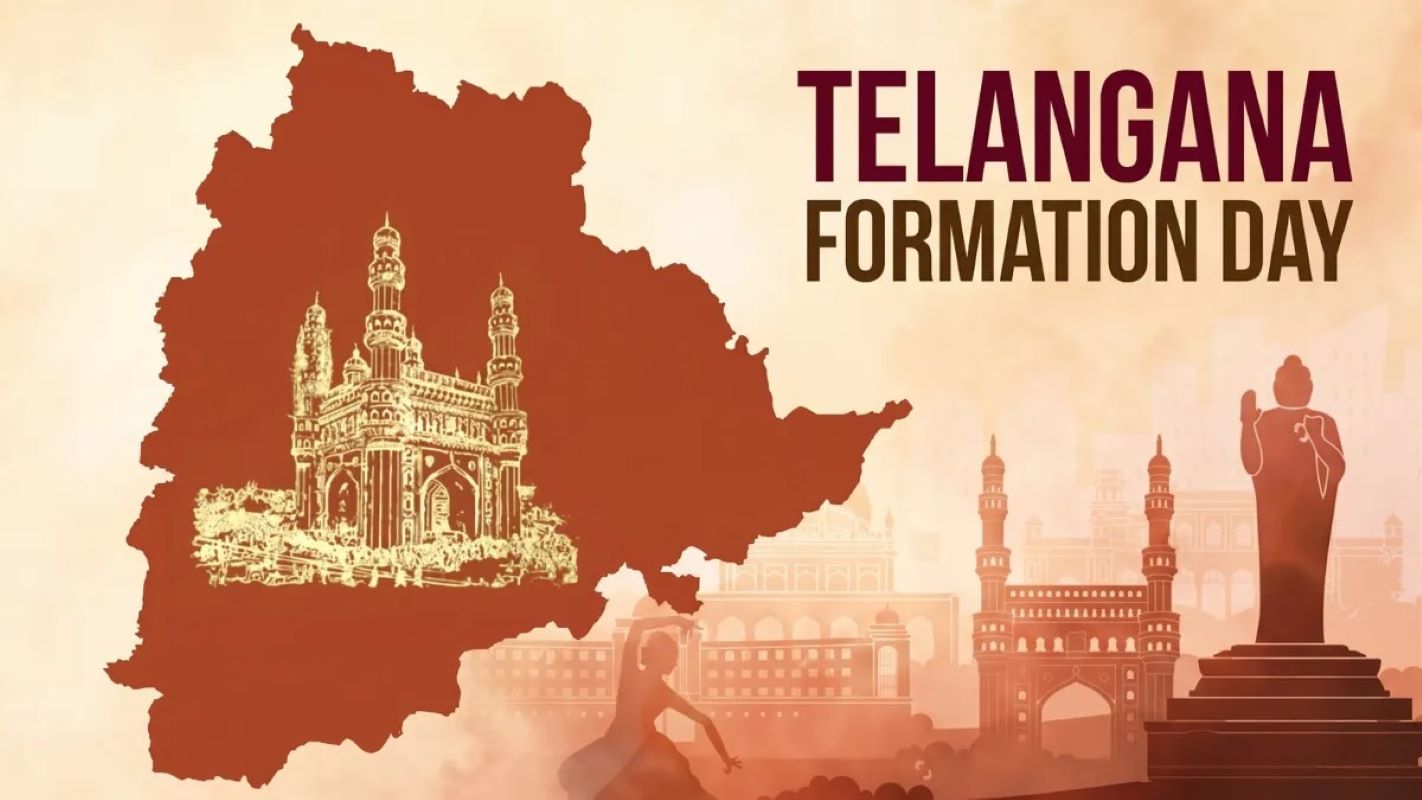
Telangana State Formation Day is celebrated every year on June 2 to commemorate the creation of Telangana as a separate state of India. On this day in 2014, Telangana officially became the 29th state of India after the bifurcation of Andhra Pradesh under the Andhra Pradesh Reorganisation Act, 2014. The occasion marks the culmination of a long socio-political movement demanding a separate state for the people of the Telangana region.
Telangana Formation Day is an important topic for competitive examinations such as UPSC, SSC, State PCS, Banking, Railways, and various state-level government recruitment exams.
Telangana State Formation Day 2026
|
Particulars |
Details |
|
Event |
Telangana State
Formation Day |
|
Date |
June 2 |
|
First Celebrated |
June 2, 2014 |
|
State Formed |
Telangana |
|
Parent State |
Andhra Pradesh |
|
Legal Basis |
Andhra Pradesh Reorganisation
Act, 2014 |
|
Capital |
Hyderabad |
|
Current Status |
One of the 28 states of India |
Formation of Telangana
Telangana was officially formed on June 2, 2014, following the division of Andhra Pradesh. The formation of the state was the result of decades of political movements, public protests, committee recommendations, and parliamentary discussions. The newly created state comprised ten districts of the erstwhile Andhra Pradesh, with Hyderabad designated as its capital. The residual state continued as Andhra Pradesh.
Legal Basis of Telangana's Formation
The creation of Telangana was made possible through the Andhra Pradesh Reorganisation Act, 2014, passed by the Parliament of India.
The Act provided for:
- Division of Andhra Pradesh into Telangana and Andhra Pradesh.
- Distribution of assets and liabilities.
- Administrative arrangements between the two states.
- Hyderabad serving as a common capital for a transitional period.
The Act came into effect on June 2, 2014, officially establishing Telangana as a separate state.
Historical Background of Telangana
Before India's independence, the Telangana region was part of the former Hyderabad Princely State, ruled by the Nizam.
Peasant Uprising and Resistance
In 1945, peasants in Telangana launched a movement against the oppressive Jagirdari system. The movement sought social justice and land reforms. The Razakars, a paramilitary force loyal to the Nizam, attempted to suppress these uprisings through violent means.
Integration of Hyderabad with India
Following independence, Hyderabad remained outside the Indian Union for a brief period. In 1948, the Government of India launched Operation Polo, resulting in the integration of Hyderabad State into the Indian Union.
Linguistic Reorganisation and Merger with Andhra
The States Reorganisation Commission (SRC) recommended the reorganisation of states primarily on linguistic lines.
Although the Commission initially suggested keeping Telangana separate, the States Reorganisation Act, 1956 merged the Telugu-speaking Telangana region of Hyderabad State with Andhra State to form Andhra Pradesh. Hyderabad became the capital of the newly formed state.
Mulki Rules and Growing Discontent
To safeguard employment opportunities for local residents, the Telangana region followed the Mulki Rules, which provided preferential treatment to locals in government jobs.
Student Protests
Concerns over violations of these safeguards led to:
- Protests in 1952 against recruitment of non-locals.
- Large-scale student movements in 1969.
- Demands for strict implementation of protections promised under the Gentlemen's Agreement of 1956.
These developments intensified the demand for a separate Telangana state.
Telangana Movement and Political Developments
Telangana Praja Samithi (1969)
The Telangana Praja Samithi (TPS) was formed in 1969 to advocate for a separate Telangana state. The movement gained considerable public support and brought national attention to regional concerns.
Constitutional and Political Changes
The Telangana issue later became associated with:
- Legal disputes concerning Mulki Rules.
- The Jai Andhra Movement.
- Imposition of President's Rule in 1973.
- The 32nd Constitutional Amendment, which introduced a zonal system for public employment and ultimately replaced the Mulki Rules framework.
Revival of the Telangana Movement
The demand for a separate state resurfaced strongly in the early 21st century.
Formation of Telangana Rashtra Samithi (TRS)
In 2001, the Telangana Rashtra Samithi (TRS) was established with the primary objective of achieving statehood for Telangana. The movement gained significant momentum after 2009 through public mobilization, political negotiations, and widespread support from various sections of society.
Justice B.N. Srikrishna Committee
To examine the Telangana issue comprehensively, the Central Government constituted the Justice B.N. Srikrishna Committee in 2010.
Objectives of the Committee
The committee was tasked with:
- Studying the demand for a separate Telangana state.
- Examining socio-economic and political implications.
- Suggesting possible solutions for the issue.
Its recommendations played an important role in the subsequent decision-making process.
Creation of Telangana State
After years of political deliberations, committee reports, parliamentary debates, and public movements, the Government of India approved the formation of Telangana. On June 2, 2014, Telangana officially emerged as a separate state with Hyderabad as its capital, marking a historic milestone in India's federal and democratic framework.
Significance of Telangana State Formation Day
Telangana State Formation Day is significant because it:
- Celebrates the achievement of statehood.
- Honors the sacrifices of people involved in the Telangana movement.
- Highlights India's democratic process and federal structure.
- Promotes regional identity, culture, and development.
- Serves as an important reminder of constitutional and political evolution in India.
Important Facts for Competitive Exams
- Telangana State Formation Day is celebrated on June 2 every year.
- Telangana became India's 29th state on June 2, 2014.
- It was created under the Andhra Pradesh Reorganisation Act, 2014.
- Hyderabad serves as the capital of Telangana.
- The Telangana Praja Samithi was formed in 1969.
- The Telangana Rashtra Samithi (TRS) was established in 2001.
- The Justice B.N. Srikrishna Committee was constituted in 2010.
- The Telangana region was formerly part of the Hyderabad Princely State ruled by the Nizam.
- Hyderabad was integrated into India through Operation Polo (1948).
- The Mulki Rules were designed to protect local employment opportunities in Telangana.
Conclusion
Telangana State Formation Day commemorates a historic chapter in India's political and administrative history. The creation of Telangana was the result of a prolonged democratic movement, reflecting the aspirations of the people of the region. Understanding the history, legal framework, and significance of Telangana's formation is essential for students, researchers, and competitive exam aspirants preparing for examinations related to Indian Polity, History, and Current Affairs.