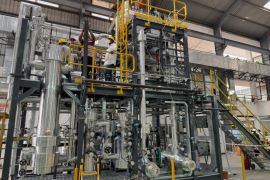
India has taken a significant step towards energy sustainability with a breakthrough by the CSIR-National Chemical Laboratory (CSIR-NCL). The institute has developed a patent-protected technology for producing Dimethyl Ether (DME)—a promising clean fuel that can potentially replace or blend with LPG.
This development is highly relevant for UPSC, State PSCs, SSC, and other competitive exams, especially under topics like environment, energy security, and science & technology.
About the CSIR-NCL DME Technology
The innovative technology focuses on advanced catalyst design and efficient process engineering to produce DME economically and sustainably.
- It enables conversion of methanol into DME using a specially designed catalyst.
- The process operates at low pressure (~10 bar), making storage and transportation similar to LPG.
- A flexible burner prototype has been developed that can run on:
o 100% LPG
o 100% DME
o Any intermediate blend
Production Process
The production of DME follows a multi-step pathway:
- Methane (Natural Gas) → converted into Syngas (CO + H₂)
- Syngas → converted into Methanol
- Methanol → converted into Dimethyl Ether (DME)
Feedstock Flexibility
One of the biggest advantages of DME is its versatility. It can be produced from:
- Natural Gas
- Coal
- Biomass (agricultural waste)
- Captured CO₂ (Carbon Capture Technology)
This makes it a future-ready fuel supporting both fossil-based and renewable pathways.
Regulatory Framework in India
The Bureau of Indian Standards (BIS) has notified IS 18698:2024, allowing:
- Up to 20% blending of DME with LPG
- Up to 8% blending without any modification to existing LPG infrastructure (cylinders, regulators, burners)
What is Dimethyl Ether (DME)?
Dimethyl Ether (DME) is a clean, synthetic fuel with multiple industrial and domestic applications. Key Characteristics
- Colourless and non-toxic gas
- Highly flammable
- Clean-burning with no soot emissions
- High cetane number (>55) → suitable for diesel engines Properties of DME
- Simplest ether with a mild odour
- Easily liquefied at low pressure (~10 bar at 40°C)
- Produces very low particulate matter and emissions
- Comparable efficiency to LPG
Applications of DME
DME has a wide range of applications:
- Substitute for diesel and LPG
- Used in aerosols (deodorants, hairsprays, shampoos)
- Acts as a chemical intermediate (olefins, methyl acetate, dimethyl sulfate)
- Used in freeze sprays for medical treatments
- Recently used in DME-powered tractors for smokeless farming
Significance of This Development
- Energy Security: India imports over 80% of its fossil fuel needs, making it vulnerable to global price shocks. DME can reduce dependency on imports.
- Cleaner Fuel Alternative: Compared to conventional fuels, DME emits: • Lower SOx, NOx, and particulate matter • No soot emissions • Comparable thermal efficiency to LPG
- Reduction in Import Bill: • India imported ~21 million tonnes of LPG in 2024 • Replacing just 8% LPG with DME can save around ₹9,500 crore annually
- Multi-Sector Use: Beyond cooking fuel, DME can be used in: • Transport sector • Chemical industry • Aerosol and refrigeration industries
- Climate & Circular Economy: DME can be produced from captured CO₂ using green hydrogen, aligning with: • Carbon Capture Utilisation (CCU) • Climate mitigation goals • Circular economy principles
Government Initiatives to Reduce Petroleum Dependency
India is actively promoting alternative fuels through multiple schemes:
- SATAT Initiative – Promotes Compressed Bio-Gas (CBG)
- Ethanol Blending Programme (E20 Target)
- National Policy on Biofuels, 2018
- National Green Hydrogen Mission
- FAME India Scheme – Promotes electric vehicles
- Methanol Economy Programme by NITI Aayog
- GOBAR-DHAN Scheme – Converts waste into biogas
Conclusion
The development of DME production technology by CSIR-NCL marks a major milestone in India’s clean energy transition. With its low emissions, flexible production sources, and compatibility with existing LPG infrastructure, DME holds strong potential to transform India’s energy landscape.
For aspirants, this topic is crucial for GS Paper III (Environment & Science Tech) and can also be asked in prelims as factual or conceptual questions.

, Jaipur, developed a low-cost sensor to detect minute amounts of toxic lead (Pb²⁺) ions in drinking water.jpg)