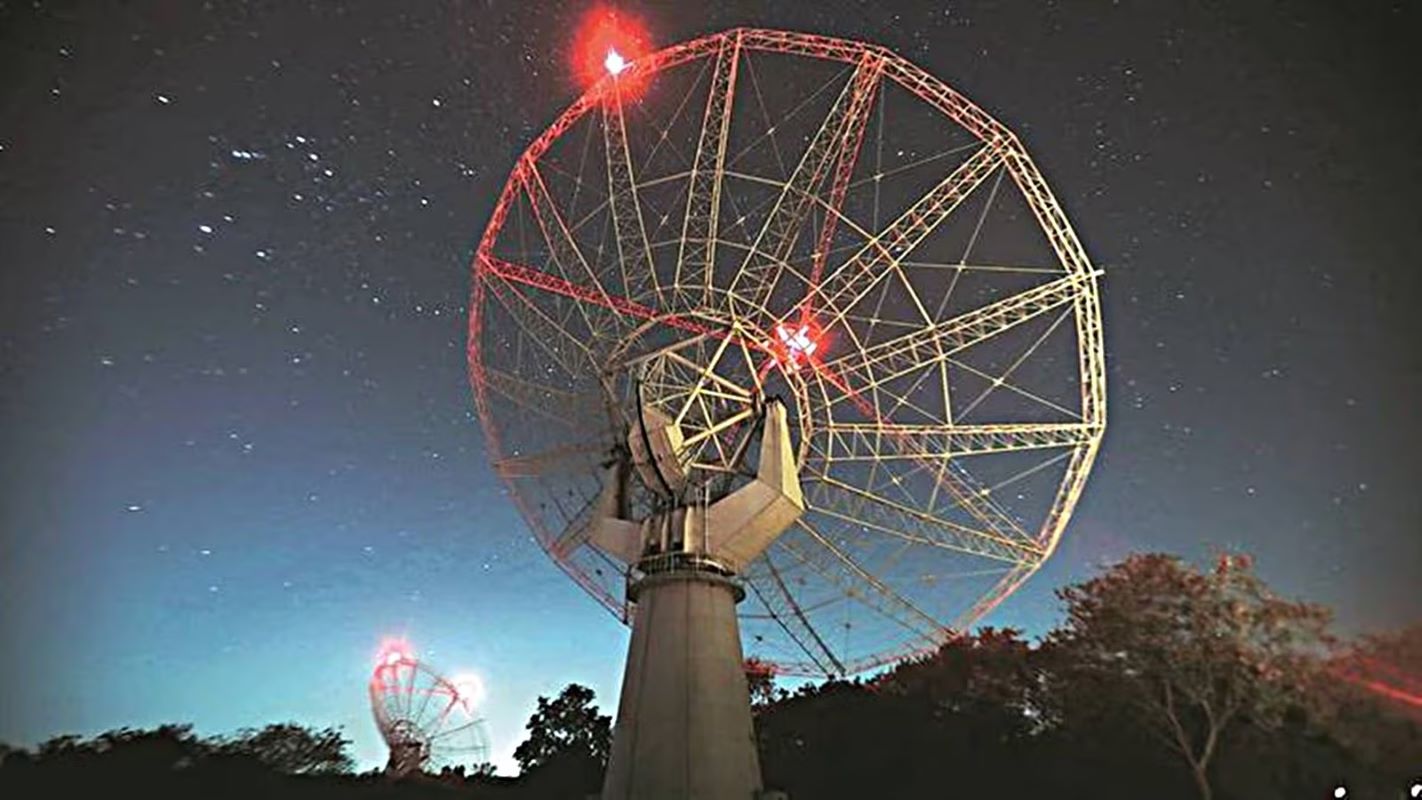
Astronomers at the National Centre for
Radio Astrophysics in Pune discovered five new millisecond pulsars using
India’s upgraded Giant Metrewave Radio Telescope
¨
Astronomers at the
National Centre for Radio Astrophysics in Pune discovered five new millisecond
pulsars using India’s upgraded Giant Metrewave Radio Telescope (uGMRT).
¨
The pulsars were detected
in the globular clusters Messier 69 and Messier 70, located in the Milky Way.
¨
These clusters are among
the oldest and most densely packed stellar systems in our galaxy.
¨
Millisecond pulsars are
rapidly rotating neutron stars with spin periods of just a few milliseconds.
¨
They typically form in
binary systems, where mass transfer from a companion star increases the neutron
star’s rotation speed.
¨
Globular clusters are
spherical, gravitationally bound groups of stars containing very old stellar
populations.
¨
Messier 69 and Messier 70
lie in the constellation Sagittarius.
¨
Of the five pulsars
discovered, two were found in Messier 69 and three in Messier 70.
¨
One pulsar, M69A, is in a
close binary system with a likely white dwarf companion.
¨ M69A completes one orbit around its companion every few days.
¨ This discovery helps improve understanding of neutron star evolution, binary star interactions, and dense stellar environments.



, Jaipur, developed a low-cost sensor to detect minute amounts of toxic lead (Pb²⁺) ions in drinking water.jpg)