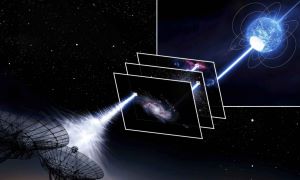
Scientists detected a fast radio burst
named FRB 20240304B that travelled about 10 billion years before reaching Earth
¨
Scientists detected a
fast radio burst named FRB 20240304B that travelled about 10 billion years
before reaching Earth.
¨
The signal was first
observed on 4 March 2024 by the MeerKAT Radio Telescope in South Africa.
¨
Researchers used the
James Webb Space Telescope to identify its host galaxy.
¨
The host galaxy is a
small, clumpy, low-mass, star-forming dwarf galaxy.
¨
Fast Radio Bursts (FRBs)
are brief and intense pulses of radio waves originating from distant cosmic
sources.
¨
FRBs are studied using
parameters such as dispersion measure, redshift, and localisation to host
galaxies.
¨
Localised FRBs help
scientists understand the intergalactic medium, galaxy evolution, and compact
objects like magnetars.
¨
Cosmic Noon refers to the
period when the universe was about 2–3 billion years old, marking peak star
formation.
¨
FRB 20240304B originated
when the universe was around 3 billion years old, during the cosmic noon era.
¨
This discovery
effectively doubled the redshift reach of previously localised fast radio
bursts.
¨
The MeerKAT telescope is
a radio telescope array that operates at radio wavelengths for deep space
observations.
¨ The James Webb Space Telescope is an infrared observatory used to study distant galaxies, stars, and planetary systems.
¨ LOFAR (Low Frequency Array) is a European network of radio telescopes used for low-frequency radio astronomy.


, Jaipur, developed a low-cost sensor to detect minute amounts of toxic lead (Pb²⁺) ions in drinking water.jpg)