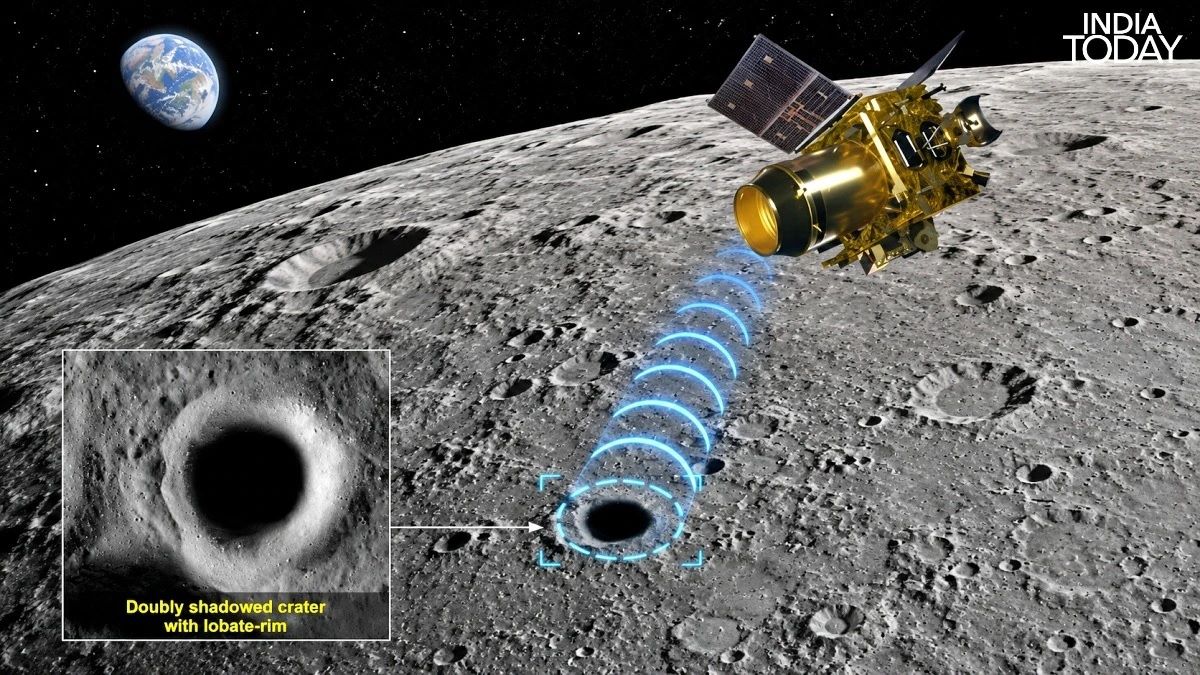
Chandrayaan-2 Data Reveals Possible
Subsurface Water Ice on the Moon
Nearly six years after its launch, India’s lunar
mission Chandrayaan-2 has provided new scientific evidence suggesting the
possible presence of subsurface water ice beneath the Moon’s south polar
regions.The findings come from a detailed analysis of data collected by the
Chandrayaan-2 orbiter, focusing on the Moon’s Permanently Shadowed Regions
(PSRs) near the lunar south pole. These regions are areas that never receive
sunlight, resulting in extremely low temperatures that allow volatile
substances like water ice to remain stable for long periods.
Key Findings of the Research
¨
Evidence of Subsurface
Ice: Scientists from the Physical Research Laboratory (PRL), Ahmedabad, used
Chandrayaan-2’s Dual Frequency Synthetic Aperture Radar (DFSAR) data to
investigate lunar south polar regions.
¨
The study identified
radar signatures consistent with the possible presence of subsurface water ice
beneath the floors of four doubly shadowed craters.
¨
Study of Doubly Shadowed
Craters: The research focused on doubly shadowed craters, located within
Permanently Shadowed Regions (PSRs).
¨
These regions never
receive direct sunlight and remain extremely cold (~25 K), making them ideal
reservoirs for preserving water ice over billions of years.
¨
New Radar-Based Ice
Detection Criterion: Scientists developed a refined method to identify
subsurface ice using Circular Polarization Ratio (CPR) > 1 and Degree of
Polarization (DOP) < 0.13.
¨
This combination
indicates volumetric scattering; a radar signature potentially associated with
buried ice.
¨
Distinguishing Ice from
Rocky Terrain: The CPR-DOP criterion helps separate genuine ice signatures from
radar reflections caused by rough rocky surfaces, improving the reliability of
ice detection.
¨
Strongest Evidence from
Faustini Crater: A 1.1 km diameter crater inside the Faustini crater showed the
strongest indications of subsurface ice.
The crater exhibits:
¨
High CPR values (>1)
¨
Low DOP values (<0.13)
¨
Distinctive lobate-rim
morphology.
Technological Achievement: DFSAR became the first
fully polarimetric Synthetic Aperture Radar (SAR) sent to study the
Moon.Operating in both L-band and S-band frequencies, it can probe below the
lunar surface and detect buried ice deposits.
Significance of the Research
¨
Improves Understanding of
Lunar Polar Volatiles: The findings provide new insights into the distribution
and long-term preservation of water ice and other volatile materials in the
Moon’s polar regions.
¨
Supports Future Lunar
Exploration: The study helps identify potential ice-rich locations suitable for
future robotic and human missions to the Moon.
¨
Enables In-Situ Resource
Utilisation (ISRU): Lunar water ice could be utilized to produce drinking
water, breathable oxygen, and hydrogen-oxygen rocket fuel for sustained lunar
operations.
¨
Reduces Dependence on
Earth-Supplied Resources: The availability of local water resources could
significantly reduce the cost and logistical challenges of long-duration lunar
missions.
¨
Strengthens India’s
Contribution to Lunar Science: The discovery underscores the continued
scientific success of Chandrayaan-2 and reinforces India’s growing role in
global lunar exploration.
¨
Aids Future South Pole
Missions: The findings provide valuable guidance for future missions targeting
the Moon’s south polar region, including landing site selection and resource
exploration.
Chandrayaan-2
¨
Chandrayaan-2 was India’s
second lunar exploration mission launched on 22 July 2019 by the GSLV Mk III-M1
rocket from Satish Dhawan Space Centre, Sriharikota.
The mission consisted of
¨
Orbiter
¨
Vikram Lander
¨
Pragyan Rover
Major Objectives
¨
Study lunar surface
geology and mineralogy.
¨
Map lunar topography and
morphology.
¨
Investigate the lunar
exosphere.
¨
Search for and quantify
water ice in polar regions.
¨
Examine the Moon’s
surface and shallow subsurface properties.
¨
Mission Outcome: On 7
September 2019, communication with the Vikram lander was lost during the final
descent phase.
¨
However, the Orbiter
remained healthy and fully operational, continuing scientific observations
around the Moon.
¨
Orbiter Orbit: The
Chandrayaan-2 Orbiter currently operates in a 100 km × 100 km polar orbit
around the Moon.
Major Orbiter Payloads
¨
CLASS (Large Area Soft
X-ray Spectrometer) – Elemental mapping of the lunar surface.
¨
CHACE-2 – Studies the
lunar exosphere.
¨
DFSAR (Dual Frequency
Synthetic Aperture Radar) – Detects water ice and studies subsurface features.
¨ IIRS (Imaging Infra-Red Spectrometer) – Maps minerals and water/hydroxyl signatures.
¨ DFRS (Dual Frequency Radio Science Experiment) – Studies the lunar ionosphere.



 scheme will continue until September 30, 2026.jpg)