Guidelines for National Security Clearance
for Renewable Energy Projects in Border Areas
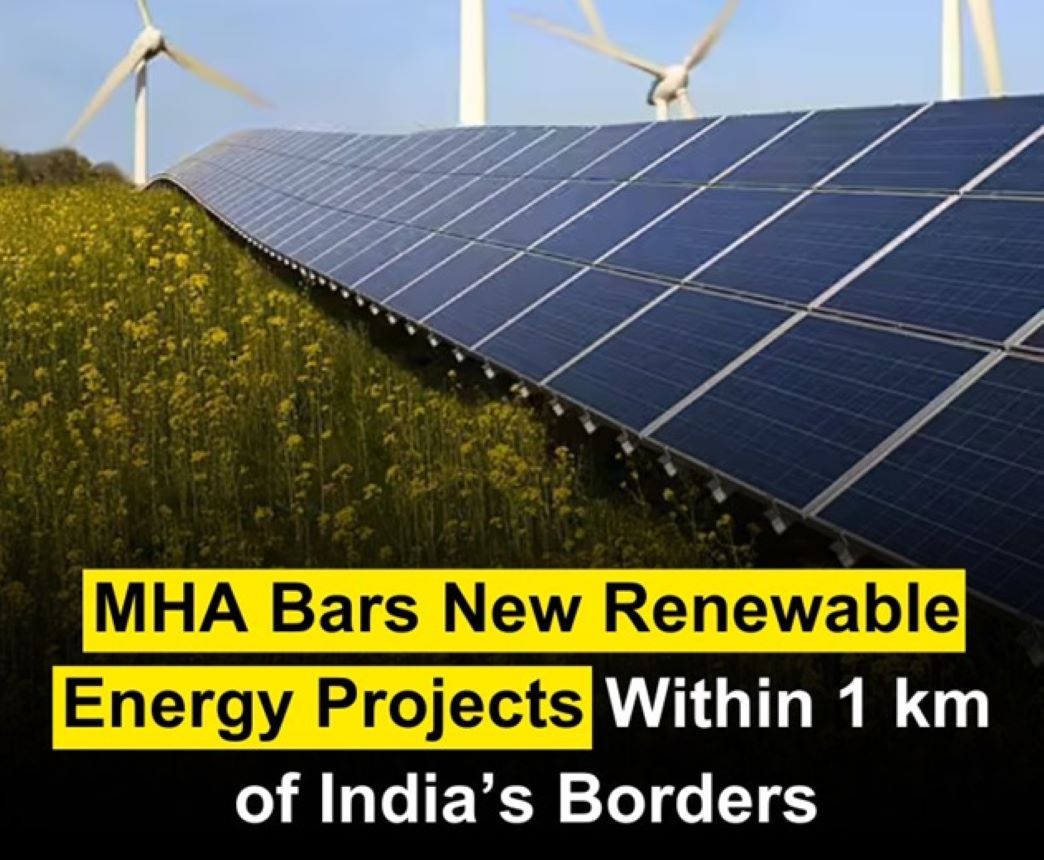
The Ministry of Home Affairs (MHA) has issued
guidelines related to national security clearance for solar, wind and hybrid
renewable energy projects in border areas. The objective of these guidelines is
to establish a balance between the development of renewable energy and national
security requirements.
Need for the Guidelines
¨
Several areas near
India’s international borders have significant potential for solar and wind
energy. Developing renewable energy projects in these areas can promote clean
energy generation, local employment and economic development in border regions.
¨
However, considering the
strategic sensitivity of border areas, it is necessary to assess
security-related aspects before such projects are developed.
National Security Clearance
¨
The purpose of national
security clearance is to ensure that proposed renewable energy projects do not
create risks to the country’s security, defence installations, border
management and strategic infrastructure.
¨
This may involve
assessing the location of a project and its potential impact from a national
security perspective.
¨
In border areas, it is
particularly important to ensure that tall structures, wind turbines, solar
installations, electricity infrastructure and communication systems do not
interfere with security and surveillance activities.
Solar and Wind Energy Projects
The guidelines mainly cover the following
types of projects:
¨
Solar energy projects
¨
Wind energy projects
¨
Hybrid renewable energy
projects
¨
Necessary electricity and
associated infrastructure
For wind energy projects, the height and location of
wind turbines may be important from the perspective of security and
surveillance.Similarly, for large solar energy parks, aspects such as land use,
connectivity with the electricity grid and distance from strategic locations
may require assessment.
Balancing National Security and Energy
Transition
¨
India has set ambitious
targets for expanding its clean and renewable energy capacity. Utilising the
solar and wind resources available in border areas can help accelerate this
energy transition.
¨
At the same time, the
requirements of surveillance by security forces, border infrastructure and
strategic installations must also be given priority.
¨
Therefore, the broader
objective of these guidelines is to promote the principle of “development with
security.”
Importance for Development of Border Areas
Renewable energy projects in border areas
are not limited to electricity generation. They can also:
¨
Promote economic activity
in border regions.
¨
Generate local employment
opportunities.
¨
Increase access to clean
and decentralised energy.
¨
Strengthen energy
infrastructure in remote areas.
¨
Support overall development
of border regions.