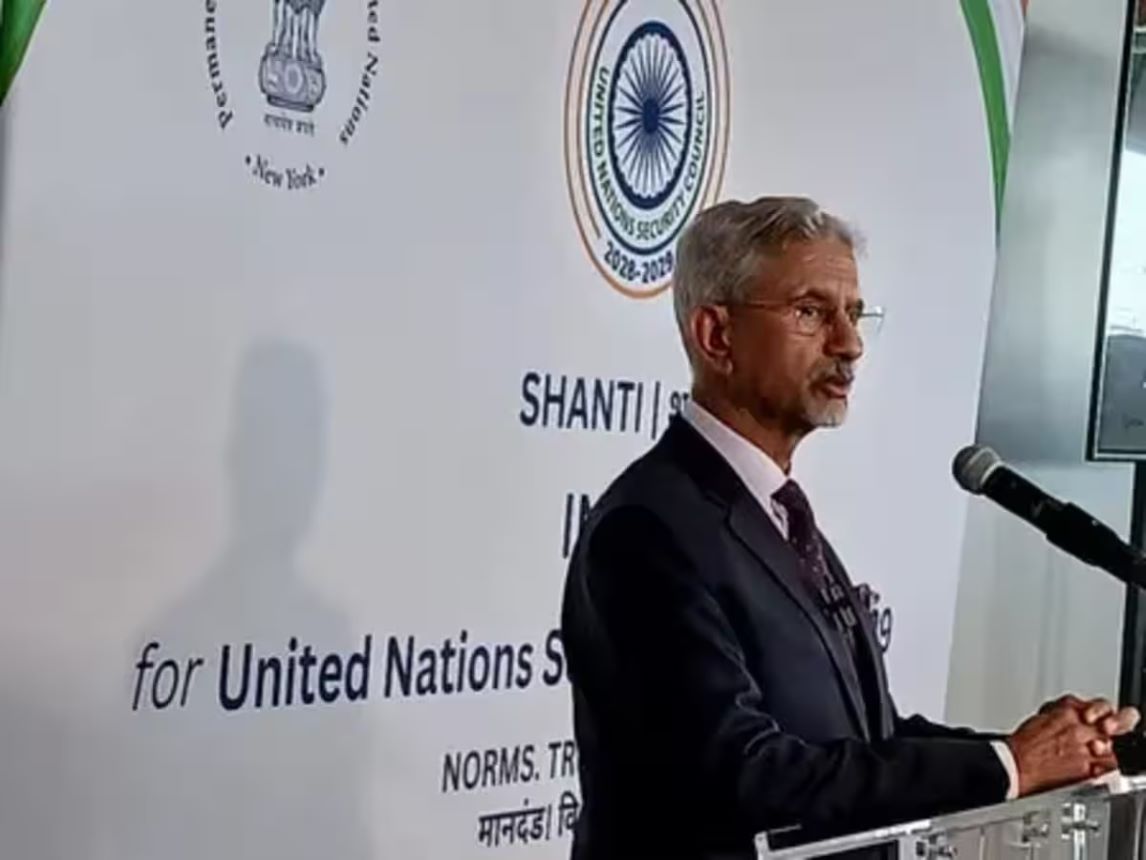
India Presents SHANTI Principle for Its
UNSC Non-Permanent Membership Campaign
India’s External Affairs Minister S. Jaishankar
introduced a new principle called SHANTI while launching India’s campaign for
non-permanent membership of the United Nations Security Council (UNSC) for
2028–29. The principle reflects India’s diplomatic vision and its commitment to
strengthening the multilateral international order.
SHANTI Principle
¨
The full form of SHANTI
is “Securing Holistic Advancement through Norms, Trust and Integrity.”
¨
The principle means
ensuring holistic progress through norms, trust and integrity.
¨
It highlights the
importance of trust, a rules-based international order and global cooperation
in international relations.
Understanding India’s SHANTI Doctrine
¨
SHANTI can be understood
as a logical evolution of India’s maritime outreach, building upon SAGAR and
MAHASAGAR.
¨
While SAGAR provided the
vision and MAHASAGAR expanded its geographical and strategic scope, SHANTI
provides the norms and methods for translating this vision into sustained
cooperation.
¨
SAGAR (2015) – Security
and Growth for All in the Region: Established the vision of inclusive maritime
security and equitable development, with emphasis on regional cooperation,
capacity building and India’s role as a preferred security partner and first
responder.
¨
MAHASAGAR (2025) – Mutual
and Holistic Advancement for Security and Growth Across Regions: Expanded this
vision to the wider Indo-Pacific and Global South, recognising the
interconnectedness of security and development across regions.
¨
SHANTI (2026) – Securing
Holistic Advancement through Norms, Trust and Integrity: Introduces the method
of cooperation, emphasising norms, trust, integrity, demand-driven cooperation
and non-prescriptive institution-building rather than influence-driven
engagement.
¨
A Shift in Security
Approach: SHANTI seeks to move from competition to cooperation, from episodic
crisis response to long-term resilience, and from protecting maritime spaces to
governing shared maritime commons.
Bay of Bengal: A Proving Ground for SHANTI
¨
Strategic centrality: The
Bay of Bengal connects India’s Act East policy with ASEAN, provides access to
the Malacca Strait, and links the eastern Indian Ocean with major global trade
and energy routes.
¨
Shared challenges: Its
littoral states face common non-traditional security challenges, including
cyclones, coastal erosion, fisheries management and protection of undersea
communication infrastructure. This creates scope for cooperation based on
shared interests rather than military competition.
¨
Institutional platform:
BIMSTEC provides an existing regional framework connecting South and Southeast
Asia. SHANTI can help align existing mechanisms rather than create another
parallel institution.
¨
From principle to
practice: The Bay is envisaged as the first region where SHANTI can be
operationalised, through cooperation in maritime security, disaster response,
blue economy and environmental resilience, before wider application across the
Indo-Pacific.
Significance for India and the Region
¨
Strengthens India’s
multilateral agenda: SHANTI provides a values-based framework for India’s
2028–29 UNSC candidature and reinforces its advocacy for reformed and
representative multilateral institutions.
¨
Advances Global South
interests: Its emphasis on equitable global governance, development
cooperation, climate justice and inclusive growth reinforces India’s role as a
voice and development partner of the Global South.
¨
Promotes a rules-based
maritime order: By emphasising international law, peaceful dispute resolution,
freedom of navigation and cooperation, SHANTI complements India’s broader
maritime initiatives and strengthens cooperative security in the Indo-Pacific.
¨
Shifts the focus beyond
hard security: SHANTI brings disaster resilience, blue economy, environmental
protection and emerging technological challenges within the broader conception
of maritime security and regional stability.