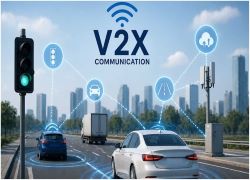
TRAI Releases Consultation Paper on V2X
Communication to Boost Emerging Telecom Technologies in India
The Telecom Regulatory Authority of India (TRAI) has
issued a consultation paper to develop a regulatory framework for
Vehicle-to-Everything (V2X) communication.V2X is an advanced communication
technology that enables vehicles to connect with other vehicles, road
infrastructure, pedestrians, and networks. Its main objective is to improve
road safety, make traffic management smarter, and reduce accidents.
More on the News
¨ The consultation paper
seeks stakeholder inputs on key issues such as spectrum allocation, licensing
models, interoperability standards, and security frameworks required for V2X
deployment.
¨ It identifies the 5.9 GHz
spectrum band—globally earmarked for V2X—as a potential candidate for India’s
implementation strategy.
¨ It reflects the growing
importance of 5G-enabled communication systems in enhancing road safety and
enabling future autonomous mobility.
Key Features of the Proposed Regulatory
Framework
¨ Spectrum Management and
Technology Choice: The framework examines optimal utilisation of the 5.9 GHz
band and evaluates technology options such as Cellular V2X (C-V2X) technology
for reliable and low-latency communication.
¨
Infrastructure and
Ecosystem Development: It emphasises the deployment of on-board units (OBUs) in
vehicles and roadside units (RSUs) to facilitate seamless communication and
real-time alerts.
¨ Interoperability and
Standardisation: The need for common standards and interoperability across
devices, networks, and regions is highlighted to ensure the seamless
functioning of V2X systems.
¨ Security, Privacy, and
Liability: The framework addresses concerns related to cybersecurity, data
privacy, and legal liability, which are critical for safe and trustworthy
deployment.
V2X Communication
¨ Vehicle-to-Everything
(V2X) communication refers to the exchange of real-time information between
vehicles and their surrounding environment, enabling intelligent
decision-making.
¨
It enables vehicles to detect
hazards “beyond line of sight” through wireless alerts and data exchange (e.g.,
speed, location, traffic signals, and collision warnings), thereby
significantly improving road safety.
It includes multiple communication modes
such as
¨
Vehicle-to-Vehicle (V2V)
¨
Vehicle-to-Infrastructure
(V2I)
¨
Vehicle-to-Pedestrian
(V2P)
¨
Vehicle-to-Network (V2N)
While early V2X systems relied on Dedicated
Short-Range Communications (DSRC), there is a growing shift toward Cellular V2X
(C-V2X) due to its ability to leverage 4G/5G networks, offer wider coverage,
and integrate more seamlessly with existing telecom infrastructure.
Significance of V2X Communication
¨
Enhancing Road Safety:
V2X enables real-time alerts regarding collisions, road hazards, and traffic
conditions, significantly reducing accidents.
¨ Improving Traffic
Efficiency: It facilitates smart traffic management, congestion reduction, and
route optimisation, improving urban mobility.
¨ Enabling Autonomous Vehicles: Reliable communication is essential for autonomous driving systems, making V2X a foundational technology for future mobility.\
¨ Strengthening Digital Ecosystem: It boosts demand for 5G infrastructure and digital connectivity, contributing to India’s broader digital transformation.


 Extended.jpg)